

 Amazon Music
 Apple Podcasts
 Audacy
 Castbox
 Castro
 Deezer
 Goodpods
 iHeartRadio
 Pandora
 RSS Feed
 PlayerFM
 PocketCasts
 Podchaser
 Overcast
 Soundcloud
 Spotify
 TuneIn
 YouTube
 The Mother Road's Leading Ladies: Tales from Route 66
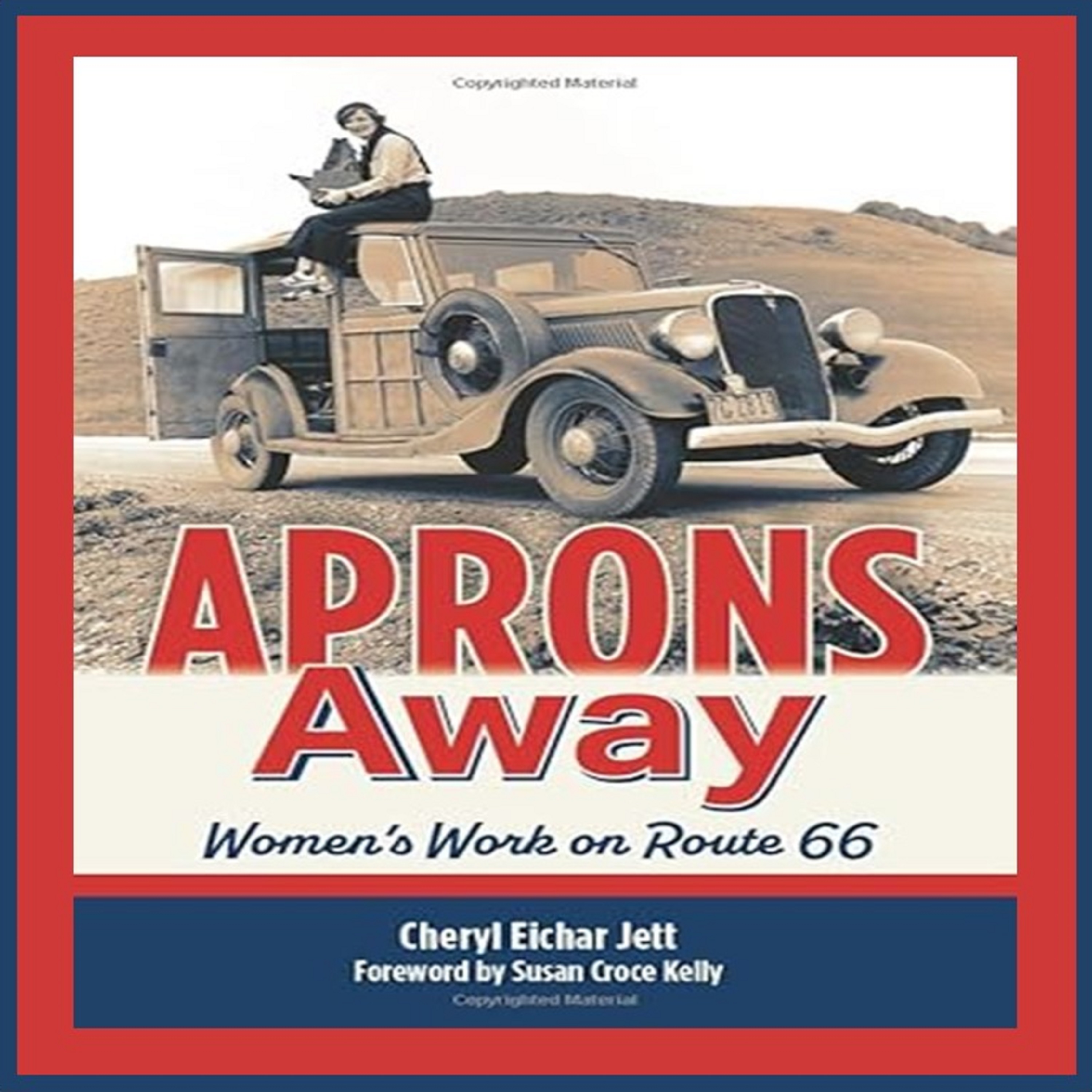
Cheryl Eichar Jett shines a spotlight on the often-overlooked contributions of women along the legendary Route 66 in her latest book, "Aprons Away: Women’s Work on Route 66", released ahead of Route 66’s 100th anniversary. Drawing on 10 years of research, she describes her criteria and her goal of balancing “visible” roles (motel, restaurant, shops, gas stations) with behind-the-scenes careers, including architects and artists. These are women from all walks of life, race, nationality, and economic means. Highlights include the Green Book, Julia Morgan’s work, muralist Miriam McKinney, St. Louis designer Maisie Georgina Krebs (SS Admiral), and anecdotes about women leaders and entrepreneurs. Join us listening about this fascinating topic, and hear some delightful anecdotes that bring these women's stories to life. You’ll want to buckle up for this enlightening ride!
When you think of Route 66, images of classic cars and diners may come to mind, but hidden within its asphalt is the rich tapestry of women’s history. In this episode, we chat with Cheryl Eichar Jett, author of 'Aprons Away: Women’s Work on Route 66,' who shares her journey of uncovering these often-forgotten stories. Cheryl brings a fresh perspective to the highway’s legacy, highlighting the pivotal roles women played in the development and maintenance of this iconic route.
She unlocks stories about the women who ran businesses, served travelers, and contributed to the culture that made Route 66 what it is today. Showcasing the resilience and creativity of women from various backgrounds, we delve into specific figures, like a trailblazing female mayor and an inspiring restaurant owner who broke barriers and created spaces for others. Each story is a testament to the strength and ingenuity of women who, despite the odds, made their mark on the American landscape. Cheryl’s passion for preserving these stories is infectious, and her witty narration keeps the conversation lively and engaging.
Wrapping things up, we reflect on the significance of Route 66 in American culture and how it serves as a microcosm of broader societal changes. Cheryl encourages listeners to explore the road and the stories behind the businesses that still stand today, offering a glimpse into the past through the lens of women’s contributions. So, whether you’re a history lover, a road trip enthusiast, or just curious about the untold stories of America, this episode is a must-listen. It’s a celebration of perseverance, history, and the incredible women who transformed Route 66 into a journey worth taking.
[00:00] Route 66 Women Intro
[00:37] Show Welcome
[01:27] Steinbeck Mother Road Quote
[02:25] Meet Author Cheryl Eichar Jett
[02:58] Play Versus Book Origins
[04:26] Route 66 Start To Finish
[05:17] Driving Time And Decommissioning
[07:01] Choosing Stories For The Book
[10:39] Route 66 as an American Microcosm
[13:53] Biggest Research Surprises
[17:53] Women Work Beyond Wartime
[19:12] Favorite Women And Sassy Tales
[24:49] Murals And Edwardsville Connections
[27:37] Gas Station Gals And Legacy Stops
[31:07] Apple Valley Ranch
[32:24] Green Book Travel Stops
[34:10] Riverfront SS Admiral
[34:51] Maisie Krebs Origins
[36:21] Art Deco Ship Design
[39:17] More Stories Volume Two
[39:43] Signings And Website
[42:11] Route Or Route Debate
[44:40] Dred Scott Petition
[46:07] Route 66 Mental Floss
[48:46] Days of the Dayr
[51:16] Humor And Farewell
Takeaways:
- Route 66 isn't just a road; it’s a historical tapestry woven with the stories of countless women who shaped its legacy.
- Cheryl Eichar Jett, our fab guest, dives deep into women's pivotal roles along Route 66, showcasing their contributions like never before.
- From waitresses to architects, the women of Route 66 had diverse careers that defy the traditional narratives we often hear.
- Did you know the term 'Mother Road' was coined by John Steinbeck in his novel 'The Grapes of Wrath'? It's a game changer for understanding this iconic highway.
Presentation & Book Signing
- Saturday, June 6th, from 11am – 1:30pm West End Service Station (Edwardsville Route 66 Visitors Center), 620 St. Louis St., Edwardsville, IL 62025; Free and open to the public
- Saturday, June 13th, from 10am – 7pm Route 66 Festival, Edwardsville City Park, 101 S. Buchanan St., Edwardsville, IL 62025: Free and open to the public
- Sunday, June 14th, from 2pm – 3pm Old Courthouse, 11 N. 4th St., St. Louis, MO 63102; Free and open to the public
- Wednesday, June 17th, from 7pm -8pm White Oak Library, 121 E. 8th St., Lockport, IL 60441; Free and open to the public
- Saturday, June 20th, from 11am – 1pm Litchfield Museum & Route 66 Welcome Center, 334 Historic Old Route 66 North, Litchfield, IL 62056; Free and open to the public
- Thursday, July 23rd, from 6pm – 7pm Hayner Public Library, 132 Alton Square Mall Drive, Alton, IL 62002; Free and open to the public
- Sunday, August 9th, from 1pm – 4pm Litchfield Museum & Route 66 Welcome Center, 334 Historic Old Route 66 North, Litchfield, IL 62056; Free and open to the public
- Thursday, August 13th, from 9am – 10am National Museum of Transportation, 2933 Barrett Station Road; Open to the public (i.e. ticketed, admission fee)
- Cheryl Eichar Jett - Website
- About Cheryl Eichar Jett - The Route 66 Chick Blog Page
- Facebook - Cheryl Eichar Jett
- Aprons Away: Women’s Work on Route 66 – Reedy Press
- Amazon - Cheryl Eichar Jett
This is Season 9! For more episodes, go to stlintune.com
#route66 #motherroad #greenbook #getyourkicksonroute66 #getyourkicks #grapesofwrath #johnsteinbeck #Route66women #womeninhistory #Route66heritage #Route66centennial
Thank you for listening. Please take time to rate us on Apple podcasts,
Podchaser, or your favorite podcast platform.
00:00 - Untitled
00:00 - The Role of Women Along Route 66
01:26 - Introduction to Route 66 and Its Cultural Significance
11:00 - The Legacy of Route 66 and Its Historical Significance
17:49 - Women in History: Contributions and Challenges
28:25 - The Legacy of Women's Influence on Route 66
34:51 - The Journey of Maisie: From Vaudeville to Artistry
47:22 - Exploring Route 66: The Mother Road
50:10 - Transitioning Topics: From Personal Anecdotes to National Celebrations
Arnold
We've all heard of Route 66, but did you ever stop to think of all the women who worked along the 2,448 mile length of the most famous highway in the world?Just in time for this year's 100th anniversary of the iconic Mother Road, Arthur Cheryl Eicher Jett examines the myriad roles women played at the crossroads of Route 66 and women's history on St. Louis in Tune.Welcome to St. Louis in tune and thank you for joining us for fresh perspectives on issues and events with experts, community leaders and everyday people who make a difference in shaping our society and world. I'm Arnold Stricker along with co host Mark Langston. A good greeting to you this morning, Mr. Mark.
Mark
You're all chipper and everything.
Arnold
Hey, good morning.
Mark
Good to see that.
Arnold
Yes, it is good.
Mark
Good morning, good day.
Arnold
Yes. Good afternoon, good afternoon, good evening.
Mark
Yes. All of that all wrapped up in one. Whenever you're listening.
Arnold
Good night.
Mark
Yes. And a good night. Johnny.
Arnold
We're not signing off.
Mark
Yeah, no, not yet. But hey, it's good to see you. Good to be seen.
Arnold
Good to be seen. We're glad that you've joined us today, folks. We want to thank our sponsor, Better Rate Mortgage, for their support of the show.You can listen to previous shows@stlntune.com where you can follow us and even leave a review. Our thought to ponder today is by a very important gentleman in the literary realm. Highway 66 is the main migrant road.66 Is the path of a people in flight. 66 Is the mother road, the road of flight. He's the one who coined the phrase mother road for Route 66. None other than. Drum roll. John Steinbeck.
Mark
Oh, really?
Arnold
Yes. And that actually was the. I don't want to say the foundation, but it was an inspiration for him writing the Grapes of Wrath.
Mark
Oh, really?
Arnold
Yes.
Mark
Wow. So I learned things on this show all the time.
Arnold
We do, too.
Mark
I know. That's. Wow.
Arnold
Isn't that cool? I never knew that he coined the phrase the mother road. And that was from the Grapes of Wrath. John Steinbeck. She's gone been through a lot.Grapes of Wrath herself, I'm sure.But our author, Cheryl Iker Jett, is an American author, playwright and journalist with seven previous books, including Route 66 in Illinois and hundreds of published articles. She's known for her Route 66 in travel writing for Arcadia Publications and Root magazine. She earned a graduate degree in history from siue.And she's traced for a long time the crossroads of women's history with Route 66. And directed two productions of her stage play based on that research. Welcome to St. Louis in Tune, Cheryl.
Cheryl
Thank you. Thank you so much. It's nice to be here.
Arnold
Now, did the book come out of the play that you wrote? Is that how this kind of all came about?
Cheryl
Actually, it didn't. And that's a good assumption because the play came before the book.
Arnold
Aha.
Cheryl
But the play did not. The book did not evolve from the play.
Arnold
Okay, so what was the play about?
Cheryl
The play is about the same topic. I actually started researching this topic about 10 years ago.
Arnold
Okay.
Cheryl
And I was busy doing an awful lot of travel writing, and so my books was in fits and starts. So I spent a lot of time doing magazine articles and presentations using this material and various groups of women.And I was at a low point with the book where I thought, oh, I'm never going to get around to getting this done. And I just woke up one morning and I just had this.Not a vision, because I'm not sure I believe in visions, but I could envision these women stepping forward on a stage and telling their own stories.
Arnold
One thing Mark and I were talking about was that it's a great perspective and it's a different perspective on Route 66. And from my perspective that you. You just didn't cover Missouri.You covered all the way from Chicago to la, and you have stories of Illinois women in here. Missouri, Oklahoma. You go down Arizona, New Mexico, California. And it's nice to galen history around that, too.
Mark
And Cheryl, just for context, what's the root of Route 66? Where does it start and where does it end? Just for those that may not.
Cheryl
The eastern terminus, the original eastern terminus is Jackson and Boulevard. That intersection, that's the Art Institute intersection in Chicago.And then in 1937, it was moved out just a little way onto the new Lakeshore Drive.
Mark
Okay.
Cheryl
And the original western terminus is downtown Los Angeles at 7th and Broadway. But then that was extended, too, although it's never been looked at as official. But it became the thing to go as far as Santa Monica pier.So that 2,448 miles is the number that the National Park Service gives us. They said that is the most accurate average that we can come up with.
Mark
How long does it take someone. I'm sorry, I just. So much swimming around in my head. How long does it take to maybe drive that? I'm sure there's about.
Cheryl
That's something that's often underestimated. People think, I've got a week off. I'll drive to Chicago to Los Angeles.And the thing is, as a U.S. highway 66 was one contiguous road, although it was built on a series of generally pre made roads. But once the route was decommissioned in 1985, it was fully decommissioned.So in other words, in 1985, US Highway 66 was simply removed from the federal highway system. And then different parts of the highway reverted back to either what they were before or they became something else.So they were either surface streets with the city's administration and maintenance, or a state road, a county road, a township road. Some almost became parts of driveways, not quite, but it was just about to that point. So it's not this contiguous thing.It's signed in each state along the various alignments. But sorry, getting back to you, that's good. It really needs three, four weeks if you're going to really see everything.Because if you go shorter than that, what you find you're doing is you're driving the interstate and then you're popping off on this exit and that exit to see something that you want to see and then you're popping back on the interstate again. So you're not really getting the experience.
Mark
Gotcha. Okay.
Cheryl
So the longer the better.
Mark
Okay. Fascinating. Yeah, fascinating.
Arnold
And your description in Aprons Away, which is the name of the book, Aprons Away, women's work on Route 66, describes a variety of what I would call vocations and places, people, places and things along the way.
Cheryl
Absolutely.
Arnold
How did you determine which people, which places and which things to include in your book?
Cheryl
I'm always so afraid people are going to ask me what my criteria was. I did have some loose criteria. I preferred that it was women that had passed, women that were not still living.However, I violated that rule right away because there were several locations, particularly some vintage motels, vintage businesses where several generations of women had operated it. So it seemed really unfair to tell the oldest woman's story and then leave readers hanging. Well, who came next?There are several instances where there are living women that are described as. But it's this heritage sort of thing that was one primary thing. I tried to give a good variety of creative pursuits work roles.I tried to make it approximately half and half mix of what I call the visible women on Route 66.And of course those were the ones that served the traveling public, the ones that were a waitress or a restaurant operator or owned a souvenir shop, that sort of thing. And then the other kind of 50% or so of the women were doing jobs, businesses, creative pursuits, vocations that you don't associate with Route 66.But they were there behind the scenes, and they kind.
Arnold
They were where people would go to, like, hotels or. You have architects in here. You talk.
Cheryl
Exactly.
Arnold
You have the gas station gals, an apron and a coffee pot. Public service artists. And your research on this, I know you've been doing this for 10 years, but it's like, holy smokes.When I found out that William Randolph Hearst's father came from Missouri.
Mark
Yes, I did.
Arnold
I didn't know that.
Mark
Really?
Cheryl
No, I didn't know it before I started searching the book because I had never done research specifically on the Hearst family.
Arnold
And specifically, was it, if I recall, St. Clair or Cuba?
Cheryl
St. Clair.
Arnold
St. Claire.
Cheryl
I think it was St. Clair.
Arnold
Isn't it crazy?
Mark
That is.
Cheryl
Yeah, it really, really was. And he had made a couple trips to California, and he was one of the few that actually struck gold.
Mark
Oh, no.
Cheryl
He went. That sort of legendary thing that people pursued that most didn't accomplish.He went to California and found gold, made money, came back, got married. They went back out there. And then the connection with, of course, architect Julia Morgan was incredible.And she is basically known because she is architect of the Hearst for the Hearst family. She also the designer of the Los Angeles Herald examiner newspaper in downtown Los Angeles, which was originally a Hearst newspaper.But that's what helped to put her on or near Route 66.
Mark
Mark.
Arnold
One of the things I really enjoyed about this was black history and women's history are often left out of general history. This really fills in a lot of gaps. It provides not only what I would say. There's black women in this book, too, and I'm glad you did that.There's Native American women in this book who contributed to all along Route 66.
Cheryl
And Latina. There's some Latina women in here as well.
Arnold
So it's a really good. You call it a history book of not only the highway, but of women and their contributions in the United States during a time of.What would you say the highway would have been like the mid-30s to maybe the mid-50s?
Cheryl
It was designated 1926.
Arnold
Okay.
Cheryl
So of course, we're experiencing the centennial this year.But one of the things that I always look at Route 66 as, particularly in the earlier decades that you mentioned, it's just a microcosm of American history history, because 20s, you've got that roaring 20s thing, the prohibition, which. With Al Capone in the gangster thing in Chicago, we're really familiar with that here. But in Oklahoma, that was Missouri, that was a thing too.And then the 30s at the Great Depression and the Dust bowl immigrants. That Dust bowl situation hit Arkansas and Oklahoma. Not that Arkansas is part of Route 66, but I mean adjacent to Oma, the Great Plains.And so we saw those people heading toward California forties, World War II affected the whole country, affected all of Route 66. And that's where the, our four lane highways, particularly on Route 66, really got initiated.Because you couldn't take military traffic on a little narrow, two lane, winding, curvy highway. So that was a part of it.But when I talk about the Dust bowl, immigrants going to California, we've always had this westward movement, Manifest Destiny to go farther and let's make more states out of this Native American country. And so that's just such a symbol of Route 66 is that westward movement.Of course, those of us that are simply tourists, we've got to turn around and come back again. But the Western movement is the symbol of it.And during my research I found the funniest quote, and I can't say it verbatim, but from Frank Lloyd Wright, because Frank Lloyd Wright also traveled Route 66.
Arnold
Interesting.
Cheryl
And he knew that the, he knew the direction that people were going, whether they were Dust bowl immigrants or they were attracted by the drive your automobile, everything. The car culture in California. Frank Lloyd Wright said every now and then the continent tips a little bit and more things slide to California.
Arnold
Then if the San Andreas fault goes.
Cheryl
To the ocean, yeah, it tip a little farther. But I love that quote. And there again, it's not word for word, but I just think it's such a great quote. And it so sums up because I'm old enough.I remember going to California in the backseat of dad and mom at the wheel and heading from Illinois to California because you were going to Disneyland and you were going to Marine land of the Pacific. And my dad as a young man had been to Hollywood where he worked a while, so of course he wanted to see Hollywood again. And it's just a trope.It's just this thing where you had to go to California.
Mark
Yeah. Wow.
Arnold
Yeah. Your big, your biggest surprise in researching this and other than William Randolph Hearst's father, but.Or either in a category or for a person or for one of the States.
Cheryl
I guess it shouldn't have been a surprise, but I found the category of artistic pursuits mainly in California. And there again just what we were talking about.So I guess it shouldn't have been a surprise, but it was because I had this chart while I was working on the book and I had Two sides to the chart. And one was how many women in each category of pursuit or vocation, and then how many people are in each state?Because I didn't want it to be terribly lopsided. I was conscious of that from Illinois. I thought, I don't want to put all Illinois stories in here if it's supposed to be root.But then I ended up with Mary Coulter, Southwest in California, Architect Julia Morgan, primarily in California. Harriet Tapp Burns, that was a designer at Disney California. And then I thought, I guess that's. It's the way it is. Yeah.And the surprise that I have found, really, after I finished the book is I was surprised readers are at, you know, this woman did this at their pursuits or at. And really there. Again, that shouldn't be a surprise. Women were working at all these things all along. But.
Arnold
But is it a surprise because we just haven't heard about it?
Cheryl
Yeah, yeah. But I. I think that. Yeah. And there's another little piece of that, too, because some of these women are not, like, they're not well known.Mary Coulter's pretty well known, Julia Morgan, at least in architectural circles. But so many of these women and painters, artists, they're not associated with Route 66. That's been what the surprise has been for everybody.Oh, I didn't know she worked on Route 66.
Arnold
But you tied them into Route 66, because maybe one of the buildings that they built was a block away and people flocked there. Or there was a restaurant right there that was very popular and people flocked there.
Cheryl
Yeah, exactly.
Arnold
Okay.
Cheryl
Exactly. I was surprised by that sort of process of.
Arnold
So in.
Mark
I'm kind of sad they decommissioned the. The road. I think they should have kept it as a historical road for our country. I think it's. It's got quite a history.
Cheryl
Some of the states. It's become a scenic byway, an official scenic bywell.
Mark
But like you say, it's choppy. You have to come off. And I know it goes through, like, Staunton, Illinois. You have to.
Arnold
That's the pink elephant antique.
Mark
Yeah. It's a bit off the highway if you want to go and enjoy that. And I think Paul McCartney tried to. Attempted to drive.
Cheryl
Paul McCartney drove, I think, just about all of it.
Mark
Yeah, yeah, yeah.
Cheryl
See, but there's a lot of people that agree with that. The real purists of the road and the car folks are. Will never get over it. It was decommissioned. And I get it.
Mark
I do, too.
Arnold
Was like Americana.
Mark
Yeah. It's really a part of our. The thread of Our history here. And it's such a.
Cheryl
Absolutely.
Mark
Maybe the next president will do that, put somebody aside and redo it.
Arnold
Where did that come from?
Mark
I don't know.
Cheryl
You never know.
Mark
You never know. That's. I like the never know.
Arnold
This is Arnold Strickland, Mark Langston of St. Louis in tune also, aka you never know or you're gonna find out something that you've never known before here on the show.
Mark
This happens when you get older.
Arnold
We're more seasoned. We're talking to Cheryl Iker Jett about her latest book, Aprons Women's work on Route 66 and the title, Throw Them Aprons off Ladies.
Cheryl
Absolutely. You got it.
Mark
But the women contributed more. I guess sometimes they. I. Some people think that during the wartime, women really stepped up and did a lot of work.But these women were like all the time. Didn't matter if it was wartime or not. They were there contributing.
Cheryl
And historians, particularly women historians, have argued for years over whether The World War II years were a watershed moment or not for women going to work. And most conclude that it was not because either the jobs they did were no longer needed after the war and.Or other men folk came home and took the jobs back.But the other argument to that is that those women gained jobs, work experience in very specific trades, and they gain confidence that they could do those jobs. So I would like to argue that it certainly wasn't a total waste and.
Arnold
It also seemed applicable to other kinds of aspects of a profession. Maybe you were running a hotel and. But hey, if I've done that, I can run this other business here.
Cheryl
Absolutely. They gained skills that were transferable.
Mark
And I might say, Cheryl, I love your earrings.
Cheryl
Oh, thank you.
Mark
She has Route 66 earrings on. Just notice that you can't see it on radio, but they are Route 66. The sign. They're the federal sign shape.
Arnold
Do you have a favorite woman in here or women. And it could be several.
Cheryl
Yeah, there's several.I've been art and architecture fans all my life, so I can't help just love Mary Coulter and Julia Morgan and some of the visual artists that some of the mural artists in here. That really struck me. There were other women, just odd stories that I just really loved. One is in St. James, Missouri, the first female mayor.And you probably can expound that I love her saying, yes, absolutely. So she took advantage of the fact that women had gained the vote because when they moved to St. James, she was.They didn't have children and she thought, oh, this town could use some cleaning up. So she Ran for mayor the first time in 1921, and the women were able to come out and vote, so that was great.And she served three more terms, and she did a lot to clean up the town, and I think she slanted the seeds for public utilities, that sort of thing. But my favorite thing, of course, is she had signs made.So when you entered St. James and when you left St. James, it would say something like, please drive slow and enjoy our beautiful city. Drive fast and see our beautiful jail.
Mark
I love it. Yeah, we need more of those sights.
Arnold
Yeah, exactly.
Cheryl
She just had that sass. She just had that sass about her. And then there was a woman in Groome, Texas, that just had that same sense about her. Her name was Ruby Denton.She came from super average, probably poor family. She worked in restaurants, waitressing and cooking, and she was known as a fabulous cook.When the fellow retired from the restaurant that she was currently working at, she wanted to buy it, and she went to the bank, and they told her flatly, we don't loan money to divorced women. So she had a network of friends and distant relatives that somehow came up with the money. And she was. Ruby was a really sassy person.And there's some funny stories about her.I was lucky to interview one of her daughters, and getting to know the daughter, I think the daughter was really a chip off the old block, because when she'd tell the Ruby stories, you know, her mom's stories, it was just like, wow, this sounds really authentic. But anyway, she. She was feisty, and they all knew her as that. And one day, there were a group of men that came in off the road.There was parking there, and they pulled in, came in the restaurant, and one of them either went back out to the car to get something or went in the restroom or something, but he disappeared for a minute. And think Ruby just had that sense as a waiting on people.You know, how many people there are to take care of, or there are three people or five people or whatever. And this guy copped up behind her when he came from wherever he was, and she jumped. It startled her, and she jumped.And I think it messed up her mental count of how many people she had there. And she had an attitude toward this group until they finally left. And she said, I wonder who those people were.And somebody in the restaurant said, ruby, that was the Oak Ridge Boys. But it just demonstrated she was pretty feisty with people. She had a good heart and she liked people, but she was feisty with them.So I just thought that those two stories are just so Fun and the edge maybe that those women needed to have at the time.
Mark
Arnold sings Elvira all the time. Oak Ridge boy song.
Arnold
He had to clarify. I know.
Mark
Come on. You can do it all the time. It's that low note. I don't know how you do it.
Arnold
The I was in. Yeah. You got me speechless here. I was amazed at the. Especially in.And maybe I shouldn't be amazed in Southern California how some of the women were accepted especially in the architectural area in the early 20s and they were going to the San Francisco School of Architecture. That might not be the name of it but for lack of better words that's what I'm calling it. And then they became.They got on firms right away and then they were designing buildings and that are like prominent buildings and they had their own firms. And it was for that to happen that early that was a real significant thing. And for them to be my words allowed to.Because you just mentioned that story about this. She wants to go buy this place and she. They're not going to give her a loan because she was divorced.
Cheryl
Yeah. Yeah. And then they also. Besides telling her that they were divorced, she was also told that she got rid of a good Christian man.
Mark
Oh. Oh.
Cheryl
You know they were pretty down on Ruby. So you can understand why she ended up with an attitude.But these women that you speak of with the architects now I will say Julia Morgan had a mentor, a Bernard Maybeck who was a. Well at the time a really well known architect and he was a male architect. Safe think that assisted her to get started.
Arnold
But everybody has some kind of mentor that really helps. And then you have to perform.
Cheryl
You have to perform.
Arnold
Show your work.
Cheryl
Yes.
Arnold
And that it has to be something that people like otherwise you're not around anymore.
Cheryl
Exactly. Julia Morgan had over 700 buildings built from her designs.
Mark
Holy moly.
Cheryl
Which is I mean crazy. I don't know how many designs on average modern a living now architect would turn out but 700 seems like an awful lot to me.
Arnold
Let's talk about your other love which is the art end of that. Miriam McKinney. I'm very fond of and know her. I don't know her. She's obviously passed but I know her work.
Cheryl
Yes.
Arnold
And I didn't know that she had done some murals over at the Edwardsville Library.
Cheryl
Absolutely.
Arnold
But and also didn't know she was up in Minnesota and then down. She ended up here in. In Arkansas and in the metropolitan area. Talk about her a little bit.
Cheryl
She was really. She started out as a just normal family. Normal but she did have art influence from her family.She had father, grandfather, I think there was an uncle, too, that were not necessarily artists, but they were appreciative of art and perhaps did smart collecting. So they did move around a little bit. When her father died, they moved to Edwardsville because they had some relatives there.And they lived in the most interesting house in Edwardsville. They lived in a house that was built by an associate of Frank Lloyd Wright, Walter Burleigh Griffin, who was in Frank Lloyd Wright's office.And Walter Burleigh Griffin designed this house in Edwardsville, which is actually across the intersection from our West End Service Station, Route 66 welcome Center.
Arnold
Oh, wow.
Cheryl
And so Walter Burley Griffin designed this house for his brother. And they didn't live in the house very long. So when Miriam McKinney was young, her family moved there. So just all these weird connections.Yeah, just connections everywhere.So there was one particular artist and art instructor whose name escapes me at the moment, but she followed him from art school to art school, and then at one point, he passed away. Within a short period of time, he had passed away and her father had passed away.And she felt like she was making these start overs, you know, new starts all the time. So eventually she was without family, she was without anyone, and she decided to move back to Edwardsville. And then she did marry a man.And Edwardsville lived there for a while before she started teaching a lot in St. Louis and then ended up in Arkansas.But the first two murals that she did for the Edwardsville Public Library were part of that 1930s New Deal thing where artists and writers were being supported somewhat with federal funds. And one mural about industry, and then she did one that was about nature and crops.But the Edwardsville Library suffered a severe fire and those murals were lost. So she came back later and she painted two more murals. This time she painted children's murals. They're like fairy tales, that sort of thing.And they're still there. They're still there in our children's department in the Edwardsville library.
Arnold
I think one of the interesting things for me, because I always liked when we would drive as a kid and you'd go to a quote, unquote, filling station.
Cheryl
Yes.
Arnold
And there's a picture in here. I think gas is what, 12 cents or 15 cents a gallon? They obviously didn't have any problems back then.
Mark
No. With Iran?
Arnold
No. But how. How many of those. If you're driving down 44, Interstate 44, you do see these remnants of these old filling stations.They're just like a Little stone cottage that's maybe a one or two room. And then you got the overhang where the pumps would be and you would pull in there.But some of the stories you have in here where the women were the driving force behind these things, or they took over the gas station gals. Yeah, gas station gals, yeah.
Cheryl
And that was often the situation, not just with gas stations, but with other businesses along the route. They were mom and Pop Enterprises, but Pop wasn't there anymore.Either they were divorced or he just drove away, or he died and mom was left and mom could sink or swim.
Arnold
You also include stories about how other people took over other people's businesses, like Gay Mason and Lela Mason. And then Lena Turner took over the business and carried on and I guess cleaned up the shop or whatever.And it's not right on 66 anymore, but it's there. But it's highway, interstate's there. Talk about those stories there.
Cheryl
People have to be looking for those places because otherwise they could sit there and nobody would ever come by. And sometimes, as we know in Illinois and a lot of Missouri, the new road and the interstate is real close to. To the old road.You can see it, or it'll at an exit, it'll say old Route 66. You could get off at that exit and see it. But there's some places where that wasn't the case.And Gary Turner's Gay Perita station was one of those where it was quite a ways off the interstate. So you would need to know that it was there and wanted to see it.But that's a wonderful example of four different women that have helped either help to preside or did preside over that station. And of course, there's a living woman there now because Lena Cole Turner's daughter Barbara, and her partner has a.
Arnold
Have a carrying on.
Cheryl
Yeah, they're carrying on.
Arnold
Isn't that great?
Cheryl
And they're one of my favorite places in Missouri to stay. You could not find more hospitality than you find they have added to the kind of little complex there. And they've got a covered patio sort of thing.And when you drive in there, her partner George is right there and he says, can I get you a Coke? How about a slice of watermelon?
Mark
Oh, yeah. Okay, I'll take both.
Cheryl
Exactly. And Barbara is just one of the sweetest women I have ever met. And. And so that was one of the instances where I had to tell about all the women.And the story with the one that's there now, living and breathing and doing a fabulous job.
Arnold
In more context of history, you mentioned the Green Book, which I'm very appreciative of, and the ranch out in. Where is it? Out near la.
Cheryl
Apple. Apple Valley, Yeah.
Arnold
Apple Valley Ranch. Yeah. Talk about that. Entice the listeners to get the book and to come see you at your signings.Because we're going to talk about the signings here in a minute. But yeah, you got a few signings.
Cheryl
This couple had lived in Los Angeles and they moved out there and were able to buy some property in an area in around Apple Valley that was friendly to black folks buying property and living there, of course, which was the first hurdle.And their original idea was to start a youth ranch because they knew that there were, you know, youth in the environs of Los Angeles that needed some help. And so that was the original idea. But they couldn't make a living doing that.And at that time there weren't any programs or enough programs to sell support it. So they said, I guess we'll just make it a dude ranch.It was known afterwards as the only Negro dude ranch, what it was called, not that we use that term anymore, but being historically accurate, that's what it was called. So they had that for quite a while. It was very popular. She had bad health, which was part of why they got out of Los Angeles proper to begin with.And she wasn't real young, but she wasn't real old either when she passed away. And then he gave it up and it went through a couple different owners and then it was eventually owned by, I'm blank, Pearl Bailey. Pearl Bailey, yes.Thank you. I'm glad you just read that. And I think of various things. Times were changing.Some of the black owned business stories that I read, the owners were, sorry we got civil rights, but now the blacks don't have to do business with us. So we're losing our business. And the ranch is long gone.
Arnold
But along grocery stores along the way, gas stations along the way places, hotels, et cetera, along the way where you had to find a place to stay. And these were advertised in the Green book and I'm glad you included that.We're going to take a brief break and we're going to come back because we're going to talk about something that famously sat on the riverfront in St. Louis that was designed by a woman who's mentioned in this book. This is Arnold Stricker with Mark Langston of St. Louis in Tune. Don't go away. As strange as it may sound at better rate mortgage.We love talking to people about mortgages. Everyone in St. Louis promises a better mortgage rate. But what you really need to turn that perfect house into your dream home is a better mortgage.At Better Rate Mortgage, we open the door to so much more. So where are you in the home buying process? Researching, maybe wondering how much you can afford? House hunting.Get a pre approval from Better Rate Mortgage Ready to buy. Our team is ready to make your mortgage process fast and easy.Whether you're purchasing your first home or taking cash out to make your dream home even dreamier. Our door is open. Come on in and get started. Today. We'll show you how.Call Sean directly at 314-375-3293 or online@betterratemortgage.com Remember, at Better Rate Mortgage, a better rate is just the beginning. Betterratemortgage.com MLS Hot each 40135 and equal. Welcome back to St. Louis in Tune. This is Arnold Stricker with Mark Langston.We're talking to Cheryl Eicher Jett about her book Aprons, women's work on Route 66, and this particular woman. I was just floored because Mark and I have both been on the Admiral before, the SS Admiral.And folks, if you're not familiar with that, you can goggle it and find out what it was about. And also didn't only design the Admiral, but also designed another ship. Talk about Maisie. Georgiana Krebs.
Cheryl
I love Maisie's story that she should go back in what we talked about a while ago. My favorite women. I love this woman's story. Mazie grew up in a vaudeville family here in St. Louis. She was a vaudeville brat.And when she wasn't on the road performing with her family, she attended public school here in St. Louis. And she was very creative, very artistically creative.And she went through high school here and won a scholarship to Washington University School of Art.
Arnold
She went to Cleveland High School, folks.
Cheryl
Yeah.
Mark
Crazy. This is crazy talk. Wow.
Arnold
Keep going.
Mark
Sorry.
Cheryl
No problem. I know it's a thing that St. Louis is more high school oriented. I'm an Illinois girl, so I don't know if we do that or not.I guess maybe we do, but anyhow. So Maisie went to art school, but the scholarship didn't pay for everything. And her family was out doing what vaudevillians do on the road.And she found she taught, had to earn some money. So she taught dancing and she just got tired of doing everything. The way she put it in an interview, she said I had to do everything.It was too much Work. I was going to school and I was drawing and I was teaching dance. And so she quit school. She had a scholarship, but she quit school.But she had enough art training and enough talent that she talked her way into the Famous Bar Company back when people actually drew fashion ads for the newspaper advertising. And so that's what she did. She drew fashion ads for Famous Bar. Then she worked out of an ad agency, also in St. Louis.And her ad agency, and I believe she did some of the work for a ship or boat company up in Alton Dreff's Steamer Company. So then she took a little jaunt up to Chicago, where she worked on exhibits for the World's Fair, 1931, 1932 World's Fair.And while she was up there, representative from the Stretchfast Steamer Company came to him, came to her. This story is documented, but it sounds so contrived to me that.Okay, I'm not sure, but the story as it's been written and researched before me is that this captain from the Stretfa Steamer Company came up to Chicago, or maybe he was already there visiting the fair, but talked to Maisie and said, you know that ad agency in St. Louis that you used to work for? She said. He said, I've got a steamer, the president, that I'd like them to do some work on. Maybe they could do some design work for me.Of course, Maisie submitted her own designs and she got hired. And then when it came time to do the Admiral, then she was called back.And the training and the work that she had done in Chicago made her very aware of the sort of newfangled art deco design. And she loved that. And this Captain Stratfus was really wanting to do something different.He wanted to go the exact opposite direction from the old time, gingerbread, calliope playing, type of steamboat that something to take us into the future.And so that really, I think, it's my opinion, but I think that's one of the biggest reasons that Maisie got that job, because she was equipped to handle that style. And style she did. Everything was just elaborate and beautiful.
Mark
What an iconic book that was.
Cheryl
I read that back in those days that a woman didn't feel like she'd had a good time on the Admiral unless she had visited every one of the ladies restrooms because they were all styled differently and so very beautiful.
Mark
Is that right?
Arnold
I didn't.
Mark
I've never been in the women's restrooms in the end roll.
Arnold
I would hope not.
Mark
I know.
Arnold
What are you saying, Mark? I don't know, we're on the air here.
Mark
I enjoyed being on the Admiral a lot, but I never knew that.
Cheryl
I think he's explaining why you didn't know that. I'm throwing you around.
Mark
I found that. Okay.
Arnold
That along with every one of these things, just, like, constantly blowing my mind. The documentarians.
Cheryl
Oh, aren't they wonderful?
Arnold
It just goes on and on. Your research of this and the people that you've selected for this, just outstanding.
Cheryl
Thank you. Thank you very much. And along those lines, I had to cut so many of the stories that I had collected that I have enough for second volume.
Arnold
I was going to say, is there a part two coming?
Mark
I knew it.
Cheryl
It's. That's not official.
Arnold
The unabridged version.
Cheryl
That's a thought in my head at this point, but I would say, physically, there. There is enough material for a second volume.
Arnold
So. Speaking about material, the book is published by Reedy Press. It can.It can be purchased@reedypress readypress.com and also, if you wanted to meet Cheryl, she has some presentations and book signings. Now, I'll post this on the podcast page, but write these down, unless you're driving. Okay. So Saturday, June 6th.
Mark
Why not? Who cares?
Arnold
In Edwardsville, Illinois, at the west end Service Station. June 11th at.
Mark
Wait, wait, you're gonna be at a service station?
Arnold
Yeah, it's.
Mark
It's along route like a gas station.
Arnold
It's the visitor center for.
Mark
Yeah, okay. Okay. All right. Sorry. The feeling, it's really great.
Cheryl
Filling station restored into a visitor center.
Mark
Okay. All right. I Love it.
Arnold
Thursday, June 11th at Six Mile Regional Library in Granite City. June 13th at the.
Cheryl
Oh, I've got. I didn't. That. That has been moved to later in the year. So.
Mark
Okay.
Arnold
Tell people to be determined. Okay. All right, so cancel that one, folks. We're going to go back.
Cheryl
That one's been moved to a different.
Arnold
There's A book signing June 13 in Edwardsville City Park. June 14 at the Old Courthouse here in St. Louis. June 17 at the White Oak Library in Lockport, Illinois.A book signing June 20 at the Litchfield Museum in Litchfield, Illinois. June, July 23 in Alton at the Haner Public Library. 9 August at the Litchfield Museum.13 August at the National Museum of Transportation on Barrett Station Road. There you go.We'll post those so you can get those and make sure if you want to get the book, you can get it there or you can see her and have it signed. Are you going to. I know. It's a presentation. What do they do at a presentation. Do they go, here's your book. Is that what they do?
Cheryl
It seems so. There's a lot of words that float around that are somewhat interchangeable. Program, presentation, book, talk, lecture.And some people use one term and some use another. And I think it's all but exactly a presentation. It seems like somebody should get a book or an award.
Mark
Yeah.
Cheryl
I might add that there are quite a few more events that are not on the list that you got, but they are on my website.
Arnold
And your website is.
Cheryl
Cheryl ikerjet.com okay, I'll post that at.
Arnold
C H E R Y L E I C H A R J T T dot com.
Cheryl
Yes.
Arnold
And I'll post that on the website.
Mark
Also, I have a crazy question. I'm sorry. We're talking about words from the guy.
Arnold
That go has never been in the women's bathrooms on the ad. Only admits it.
Mark
Where words mean so many different things. Do you prefer root or route?
Cheryl
Oh, that's a funny question.
Mark
Come from a funny man. I'm a root guy.
Cheryl
Some people say route, some people say route.Our own tourism bureau across the big muddy Mississippi is great rivers and routes, but they handle Route 66, the route things got implanted in Bobby Troup's song. And since then, even if people normally say route, they usually say route.So if you look it up, then it talks about British pronunciation and English. And then are you using it for this purpose and that purpose? So say what you want, but generally for this highway, it's root.
Arnold
I can't see Nat King Cole and the trio singing get your kicks on Route 66.
Cheryl
Can't do it.
Mark
Goes back to my broadcast days in school.
Arnold
Absolutely.
Mark
It was a big conversation. Root and route.
Arnold
Okay.
Mark
And I think root is supposed to be the way, but route has developed.
Cheryl
Yeah, that's a good question.
Mark
It's a fun question to figure out how people like it. Yeah.
Arnold
Folks, if you have more questions for Cheryl, you can meet her at one of those places. But you need to get her book aprons. Woman's work on Route 66. Cheryl Eicher. Jett, thanks for coming in today.
Cheryl
Thank you so much for having me. It was really a lot of fun.
Arnold
Thank you. We're going to take a brief break. And Cheryl, you're allowed to stay here if you want. We're going to wrap things up.This is Arnold Stricker with Mark Langston of St. Louis. Tune Catch up some more mental floss about Route 66 in just a moment.Everyone in St. Louis promises a better mortgage rate, but what you really need to turn that perfect house into your dream home is a better mortgage. At Better Rate Mortgage, we open the door to so much more.Whether you're purchasing your first home or taking cash out to make your dream home even dreamier, our door is open. Come on in and get started. Today. We'll show you how.Call Sean directly at 314-375-3293 or online@betterratemortgage.com Remember, at Better Rate Mortgage, a better rate is just the beginning.Betterratemortgage.com and MLS ID 2401335 an equal housing lender this is Arnold Stricker of St. Louis in tune on behalf of the Dred Scott Heritage Foundation. In 1857, the Dred Scott decision was a major legal event and catalyst that contributed to the Civil War.The decision declared that Dred Scott could not be free because he was not a citizen.The 14th Amendment, also called the Dred Scott Amendment, granted citizenship to all born or naturalized here in our country and was intended to overturn the US Supreme Court decision on July 9, 1868.The Dred Scott Heritage foundation is requesting a commemorative stamp to be issued from the US Postal Service to recognize and remember the heritage of this amendment by issuing a stamp with the likeness of the man Dred Scott. But we need your support and the support of thousands of people who would like to see this happen.To achieve this goal, we ask you to download, sign and share the one page petition with others. To find the petition, please go to dredscottlives.org and click on the Dred Scott Petition drive on the right side of the page.On behalf of the Dred Scott Heritage foundation, this has been Arnold Stricker of St. Louis in tunes. Welcome back to St. Louis in June. This is Arnold Stricker with Mark Langston. Thank you for joining us.Aprons away A Woman's work on Route 66 Cheryl Iker Jett Gotta catch that book folks. Very good. Great paperback fun. Read about the 2,448 mile journey. So some mental flaws here.Mark about Route 66 In 1928, promoters held a foot race across Route 66. Now not just going the width, this is the length.Charles Pyle spearheaded an ambitious promotional plan for the new highway, a race from LA to New York City, which was not the end of Chicago was the end. The only catch. The race would happen entirely on foot.He dubbed it the Transcontinental Foot Race, though some skeptical newspaper reporters soon began referring to it as the Bunyan Derby.
Mark
Yeah.
Arnold
The prize was 25 grand. Nearly 300 runners set out to sprint across the country.The first 2,400 miles of the 3,400 mile race followed Route 66, with checkpoints in towns that had agreed to finance. Ultimately, Cherokee citizen Andy Payne took home the title.If you drive through Oklahoma on Route 66 today, you can still find his statue and take a moment to consider how lucky you are to reach your final destination on wheels. And in fewer than 573 hours.
Mark
Wow. Wow. Where did they sleep along the way? They just stop and jump in a ditch.
Arnold
Crazy.
Cheryl
Anywhere they could.
Arnold
So I mentioned about John Steinbeck earlier.
Mark
Yes, I remember.
Arnold
And he nicknamed Route 66 the Mother Road. It's gone by many names since its 1926 inception, including America's Main street, but Steinbeck's the Mother Road.In his Depression era novel, the Grapes of Wrath, he tells story of the poor family who flees Oklahoma for California during the Badus Bowl. They travel along Route 66 with thousands of fellow migrants. He said 66 is the path of people in flight. 66 Is the mother Road, the mother of Flight.
Mark
Wow, that's great.
Arnold
There's a couple other things. The Great Depression spurred thousands to head west, which we just kind of found out. The New Deal helped finish Route 66.Oh, I has a long military history. It crosses how many states?
Mark
I'm going to have to think about that. Let me see.
Arnold
Eight states, 2400 paved miles ran from the Great Lakes to the edge of the Pacific. So we have Missouri, Nebraska, Oklahoma, Texas, Arkansas, Arizona and New Mexico before arriving in Southern California.The longest stretch drivable is in Oklahoma.
Mark
Wow. Okay. Who knew? We're gonna have to find that drum roll for you.
Arnold
Yeah.
Mark
I'm not sure where it went. I think the drums are.
Arnold
The snare's been turned off.
Mark
They're working on the drum somewhere over there. Oh, wait. I think we found it. Okay, next time. Okay.
Arnold
You have any day? Is it Route 66 day?
Mark
No, it should be. It's American Indian Citizenship Day.
Arnold
Well, that works too.
Mark
Yeah.
Arnold
Doesn't that?
Mark
It's close to what with what's been happening here. National Bubba Day.
Arnold
Oh, that's every day, isn't it?
Mark
No, it's not.
Arnold
Depends on who you meet that day.
Mark
I know it. Let's see. National First Ladies Day.
Arnold
Okay.
Mark
I don't know. My wife was a First lady when I was a mayor. She was the first lady of Maplewood.
Arnold
Yeah.
Mark
She even has a shirt says First Lady. She hated it. Okay, National. I love my dentist. Day. This is your favorite day, isn't it? Arnold's had more work.
Arnold
He had more work in the dentist chair. I can sleep in the dentist chair.
Mark
It seems like every time his kid is going to college, you have a.
Arnold
Lot of work or he needs a car painting. That's what I said. One time I went into the oral surgeon. You got to pay for your kitchen.
Mark
I believe it. National Rocky Road Day. Do you like Rocky Road, anybody? No. You're not a Rocky Road.
Arnold
I'll eat it.
Mark
Well, yeah. Yeah, okay.
Arnold
I'll eat all ice cream.
Mark
Yeah. Let's see. Republic Day in Italy. If you. I have a friend going.
Arnold
Republic Day. Which. Which government are they on now?
Mark
Who knows? I know.
Arnold
513Th, and this is for everybody.
Mark
National leave work early day is today. So we're going now. We're not going to finish the last 10 minutes. We're done. We're out of here. Sorry. Okay. Just going to go quiet.
Arnold
We don't have any fun on this show.
Mark
It's going to go quiet all of a sudden. And that's just a few of the many things that Congress has passed because they're doing that instead of the important.
Arnold
Things of life for us.
Mark
National Best Friends Day. How about that? That's coming up. National Best Friends Day.
Arnold
Okay.
Mark
World Bicycle Day.
Arnold
Yeah.
Mark
Are you still riding your electric bike?
Arnold
Yes, I am.
Mark
There's a big thing about those lately.
Arnold
I love them.
Mark
About the young kids, the youngsters.
Arnold
They're all riding them too now.
Mark
Yeah. Running people off.
Arnold
They don't pedal.
Mark
They just.
Arnold
Just turn the throttle on.
Mark
I was just looking at one the other day going, gosh, if I had that when I was a kid, I probably would have been in a lot of trouble.
Arnold
Yeah.
Mark
Or run into a lot of things or.
Arnold
Yeah, that's why I have a bell. I want a truck horn.
Mark
Oh, yeah. You need one of those. Yeah. You need a train horn?
Arnold
Yeah, that would be great.
Mark
Okay.
Arnold
All right. Mark, do you know if mediums can communicate with the dead? Just imagine what a large can do.
Mark
It's gonna get worse, Cheryl. You know, I got this for you.
Arnold
Guy got pulled over by a police officer and said, a speeding ticket. What am I supposed to do with this? Police officer said, you can collect them, and when you get five, you get a bicycle.So don't laugh too hard about this one. In their first biochemistry class, medical students were standing around a table with a urine sample.The professor dipped his finger into the sample and then tasted it. He then asked the students to do the same. They felt uncomfortable but after some time, all of them followed his example and tasted it.After everyone finished, the professor said, this is really important, folks. I'm serious. The most important skill is observation. I dipped my middle finger, but I tasted my index finger. Today you learned how to pay attention.
Mark
Oh, my gosh. That's good.
Arnold
Goodness.
Mark
A tough room. It's a very tough room.
Arnold
Okay, so you're playing the Oregon Trail, and you run into a man named Terry. You laugh at him and say, that's a girly name. Terry shoots you. You have died from dysentery.
Mark
Wow, Arnold.
Arnold
And a tourist was admiring the necklace worn by a local Native American. What is it made of? She asked. Alligators. Teeth, he replied. She said in a patronizing manner, that they mean as much to you as pearls do to us.Oh, no, he objected. Anyone can open an oyster.
Mark
Wow. Kiss your wife with that mouth.
Arnold
And lastly, I was the best man at my brother's wedding in Paris. At the reception, I raised my champagne glass and said, egg, cinnamon bread and maple syrup. It was a French toast.
Cheryl
Take a bow.
Mark
Oh, my God.
Arnold
That's all for this hour, folks. Thank you for joining us.If you've enjoyed this episode, you can listen to more episodes@stlintune.com where you can leave a review and also follow us. We want to thank Bob Berthisel for our theme music, our guest, Cheryl Eicher Jett, and co host Mark Langston.And we thank you for being a part of our community of Curious Minds. St. Louis and Tune is a production of Motif Media Group and the U.S. radio Network.Don't forget, keep listening, keep learning, walk worthy, and let your light shine. For Saint Lucian tune, I'm Arnold Stricker.
Mark
Sam.


